
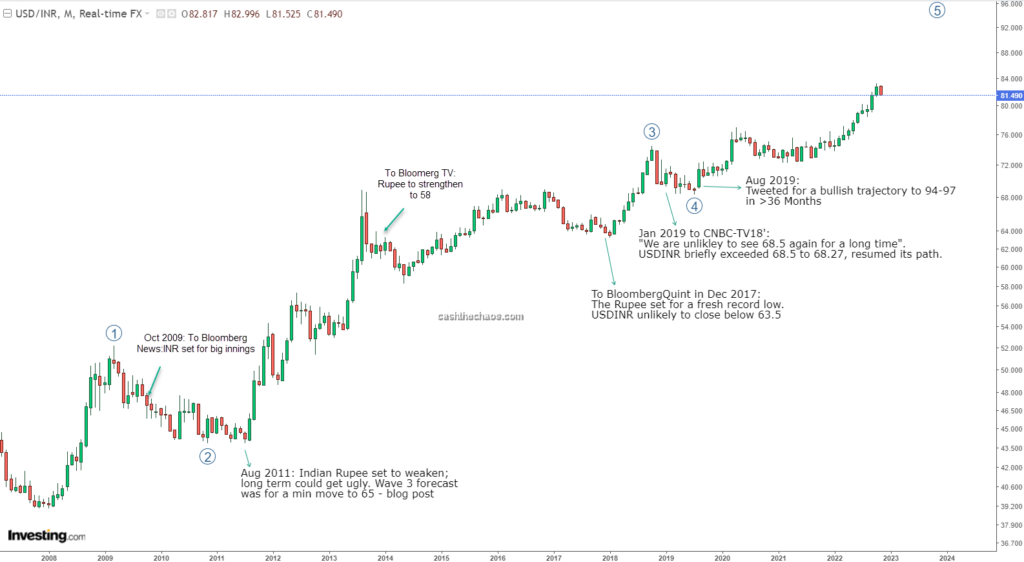
For over a decade, the consensus around the Indian Rupee was repeatedly framed through macro narratives, policy expectations, rate differentials and economic logic.
Yet structurally, the larger trend kept asserting itself.
Back in 2011, when I projected a long-term depreciation cycle toward levels that seemed improbable at the time, the overwhelming institutional consensus was still looking for Rupee strength — some forecasts even projected 38/USD.
Again in 2013. Again in 2017. Again in 2019.
Today, with USDINR continuing to print historic highs even in 2026, it raises an interesting question:
How much of market behaviour is truly driven by the “reasons” we attach to it afterwards?
And how often do those reasons simply emerge after the structure is already in motion?
One of the most misunderstood aspects of Elliott Wave analysis is that it is not attempting to predict news, economics or events.
It attempts to identify the underlying behavioural structure of markets before consensus narratives adapt to it.
The uncomfortable reality for many fundamental frameworks is that markets often move first — and explanations arrive later.
Not always. But often enough to matter.
That distinction becomes especially important at major turning points.